
The Great Migration in the Masai Mara is the annual arrival of over 1.5 million wildebeest and 200,000 zebras crossing from Tanzania’s Serengeti into Kenya between July and October. Driven by seasonal rains, herds face dramatic Mara River crossings to access fresh grazing pastures while tracking resident predators.
By Daniel Sambu, TRA-Licensed Safari Guide | Reviewed by James Sindiyo
Daniel Sambu is a wildlife and community conservation guide working across the greater Mara ecosystem. James Sindiyo is a veteran Mara guide recognised for his birding and predator tracking knowledge in the reserve.
The noise hits you long before the herd touches the water. It is a deafening, relentless roar of thousands of animals braying through choked red dust. By mid-August, the riverbanks smell like damp fur, river mud, and decaying carcasses. It is loud, messy, and intensely raw.
Summary
The great migration masai mara brings massive wildebeest herds across the Mara River from July through October. Our local guide breaks down month-by-month movement, river crossing points, park fee changes, photography camera settings, and exact 4×4 Land Cruiser package costs.
Jump To
- Migration packages and pricing options
- Park fee seasonal split note
- Month by month migration movement schedule
- River crossing point comparison matrix
- The 3+2 night split strategy
- Migration photography specs and settings
- Frequently asked migration safari questions
Planning a migration trip around fixed dates? Our 5-day Masai Mara and Lake Nakuru safari and 3-day Masai Mara safari itinerary are the two most booked road routes in season. The 4-day Masai Mara safari itinerary buys an extra morning at the river, and the 7-day luxury Masai Mara fly-in safari skips the road entirely.
Great Migration Masai Mara Safari Packages & Prices
Great Migration safari packages cost between $1,290 and $8,290 per person based on two adults traveling together. Rates vary by travel season, choice of safari camps, vehicle type, and whether you fly or drive from Nairobi.
| Package Tier | Suggested Accommodations & Routes | Price Per Person (Sharing) |
| 3-Day Migration Express | 3-Day Route: Sarova Mara Game Camp / Enkorok Mara | $1,290 to $2,450 |
| 4-Day River Crossing Pursuit | 4-Day Route: Entim Mara Camp / Mara Bush Camp | $2,140 to $4,130 |
| 5-Day Migration & Nakuru Circuit | 5-Day Route: Lake Nakuru Sopa & Mara Intrepids | $2,610 to $4,710 |
| 5-Day Luxury Fly-In Migration | 5-Day Fly-In: Chui Lodge (Naivasha) & Governors’ Il Moran | $5,240 to $8,290 |
Ready to Track the Herds? Start planning your Mara safari with our local team. Custom quotes available.
Included in All Packages
- Full-board accommodation in luxury tents or safari lodges
- Exclusive use of a private custom 4×4 Safari Land Cruiser with pop-up roof hatch, driver-guide, and fuel
- Park entry fees remitted directly through the official Narok County and eCitizen portals ($100 low / $200 peak daily rate)
- Nairobi airport or hotel transfers, plus bottled drinking water inside the vehicle
Excluded from All Packages
- International flights to Nairobi (NBO) and mandatory electronic travel authorization fees
- Alcoholic drinks, soft soda beverages, and personal laundry
- Driver-guide gratuities ($20 to $30 daily total per group)
- Optional hot air balloon safari over the Mara River ($450 to $500 per person)
Booking Terms & Postponement Policy
We require a 20% deposit to confirm your migration package. Upon getting the deposit, we book and fully pay for your chosen lodges, providing you with official booking vouchers issued directly under your name. You can call or email the hotels directly using your voucher number to verify your booking is secured and fully paid before making further payments.
Once verified, you pay a further 30%, bringing you to 50%. The remaining 50% balance is payable in crisp USD cash or credit card at pickup on Day 1, or via bank transfer seven days prior to departure. We accept Visa, Mastercard, Stripe, PayPal, Wise, Payoneer, and Skrill.
Cash refunds are not issued for traveler cancellations because deposit funds are remitted immediately to secure non-refundable room locks and driver schedules. Guests retain 100% of their deposit credit to postpone and reschedule their safari to any future date. Cancelling inside 90 days can cost part of that value depending on the lodge, and inside two weeks the lodges apply strict retention terms.
Peak Season Fee Note
Travelers comparing migration package pricing will notice a steep jump in rates between low and peak seasons.
Narok County park entry permits double from $100 per 24 hours (January to June) to $200 per 24 hours (July to December) per non-resident adult. On a 4-day or 5-day migration itinerary requiring three or four 24-hour passes, that surge adds $300 to $400 per person directly to your total package bill, before lodge peak-season surcharges.
For the wider cost picture in peak months, check our guide on how much a Masai Mara safari costs.
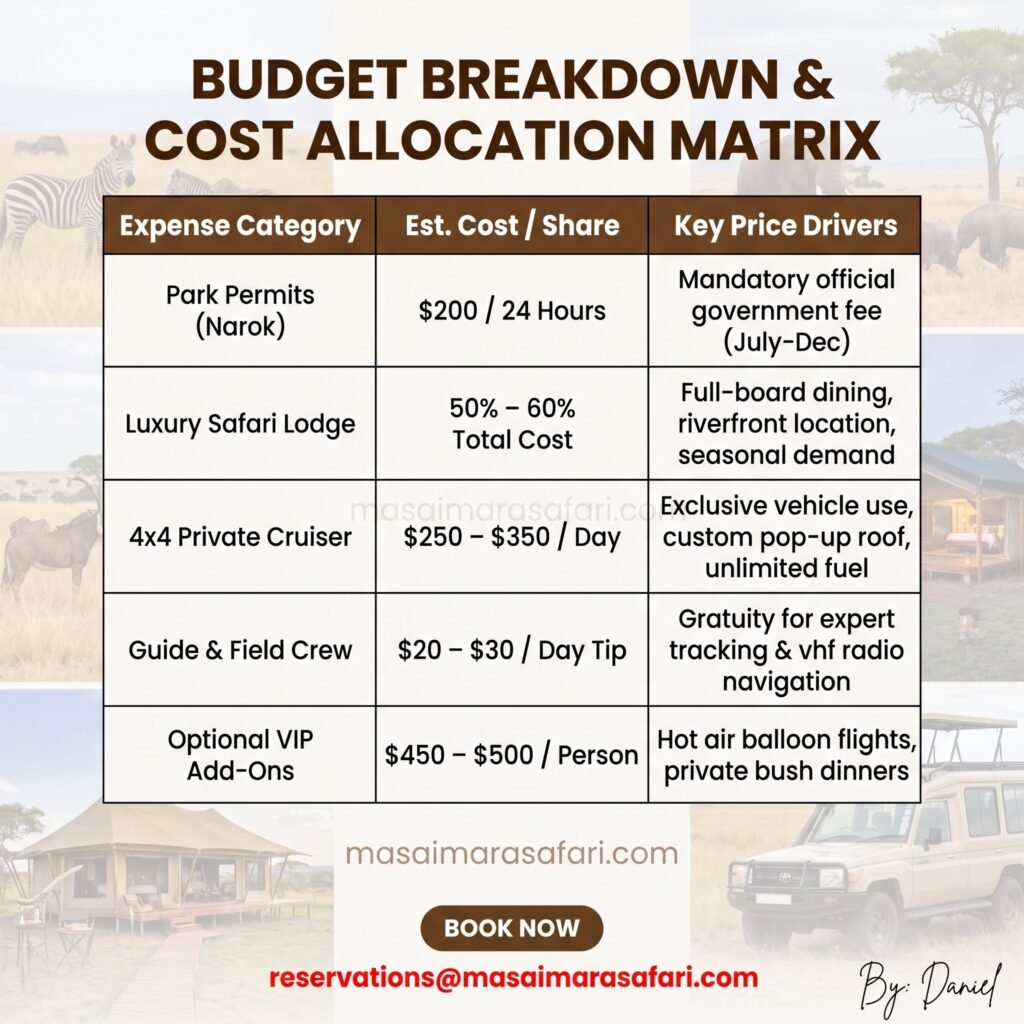
Budget Breakdown & Cost Allocation Matrix
Understanding where your money goes is crucial when budgeting for a Great Migration safari. Peak season costs are heavily driven by fixed, non-negotiable park entrance permits and high-demand lodge tariffs. Here is an exact breakdown of how your safari investment is allocated across a standard 4-day peak season itinerary.
| Expense Category | Est. Cost / Share | Key Price Drivers |
| Park Permits (Narok) | $200 / 24 Hours | Mandatory official government fee (July–Dec) |
| Luxury Safari Lodge | 50% – 60% Total Cost | Full-board dining, riverfront location, seasonal demand |
| 4×4 Private Cruiser | $250 – $350 / Day | Exclusive vehicle use, custom pop-up roof, unlimited fuel |
| Guide & Field Crew | $20 – $30 / Day Tip | Gratuity for expert tracking & vhf radio navigation |
| Optional VIP Add-Ons | $450 – $500 / Person | Hot air balloon flights, private bush dinners |
Month-by-Month Migration Movement Schedule
Where the herds congregate changes as rainfall patterns shift across the greater Mara-Serengeti ecosystem:
| Month | Herd Location & Movement | Wildlife Behavior & Guide Observations |
| July | Sand River & Southern Mara boundary | Herds cross from Tanzania into Kenya; early river crossings begin along Sand River |
| August | Central Mara & Mara River loops | Peak Migration density; dramatic Mara River crossings occur daily at major river points |
| September | Mara Triangle, Musiara & Northern Conservancies | Herds spread across open grass plains; intense lion and cheetah hunting activity |
| October | Central plains & Southern boundary | Herds graze down remaining grass before beginning their southward trek back to Serengeti |
| Nov to June | Southern Serengeti & Ndutu plains | Resident big cats remain in Mara; lower park fee rates ($100/day) and quiet tracks |
When you book direct with a local Kenyan operator, you get experienced driver-guides who monitor low-frequency VHF radio channels to track Sand River herd concentrations before public tour minivans spot them.
If you are still choosing which side of the border to watch this from, our Masai Mara vs Serengeti comparison covers the trade-offs.
River Crossing Point Comparison Matrix
A wildebeest river crossing is never guaranteed on a fixed clock. Knowing where herds gather helps you position your Land Cruiser effectively:
| Crossing Point | Location Sector | Riverbank Terrain | Vehicle Density | Best Experience For |
| Cul-de-Sac (#4) | Central Mara River | Steep clay banks, narrow bend | High | Intense herd bottlenecks & river plunges |
| Main Crossing | Central Reserve | Wide gravel exit, gradual slope | Very High | Large volume crossings across broad water |
| Lookout Crossing | Southern Boundary / Mara Triangle | Shallow rapids, rocky ledges | Moderate | Unobstructed photography & fewer vehicles |
| Paradise Plain | Musiara Marsh Sector | Deep channels, muddy banks | Moderate to High | Nile crocodile ambush & predator activity |
James Sindiyo, who has worked these crossings for over ten years, is firm on timing: get to a riverbank watching point before 8:00 AM and you take a prime spot without parking across the exit corridor the herd needs. Arrive late and you are either behind thirty vehicles or in the animals’ way.
Our Mara River crossing guide goes into each point in more detail.
The 3+2 Night “Split Strategy” for Migration Travelers
To get the most out of a peak season trip without getting burned out by vehicle crowds, we recommend splitting your stay between two distinct sectors:
3 Nights in the Reserve: Stay at a riverfront camp inside the main reserve (such as Entim Mara or Governors’ Camp). This puts you parked on the river ridge with your engine turned off early in the morning before main gate traffic arrives.
2 Nights in a Private Conservancy: Move to a private camp in Mara North or Olare Motorogi Conservancy. This unlocks quiet off-road cat tracking, night game drives with infrared spotlights, and guided bush walks away from reserve vehicle crowds.
Read our full comparison on Masai Mara reserve vs private conservancies to understand how conservancy boundaries work.
Migration Photography Specs & Camera Settings
Capturing fast-moving river crossings through heavy river dust requires specific gear and camera adjustments:
- Lens Selection: Bring a primary 100 to 400mm or 200 to 600mm telephoto lens to capture long-range riverbank leaps, plus a secondary 24 to 70mm lens for wide, sweeping landscape shots of the massive herd.
- Action Camera Settings: Set your shutter speed to at least 1/1600s to freeze water spray, leaping wildebeest, and sudden crocodile strikes. Keep your aperture around f/5.6 to f/8 for depth of field across the riverbank.
- Dust Care: Bring a fitted silicone camera cover or a sealable dry-bag to protect your camera body and lens mounts from fine grey dust kicked up by thousands of hooves on dirt tracks.
If photography is the point of the trip rather than a side benefit, our Masai Mara photography safari guide covers vehicle setup and guide briefing.
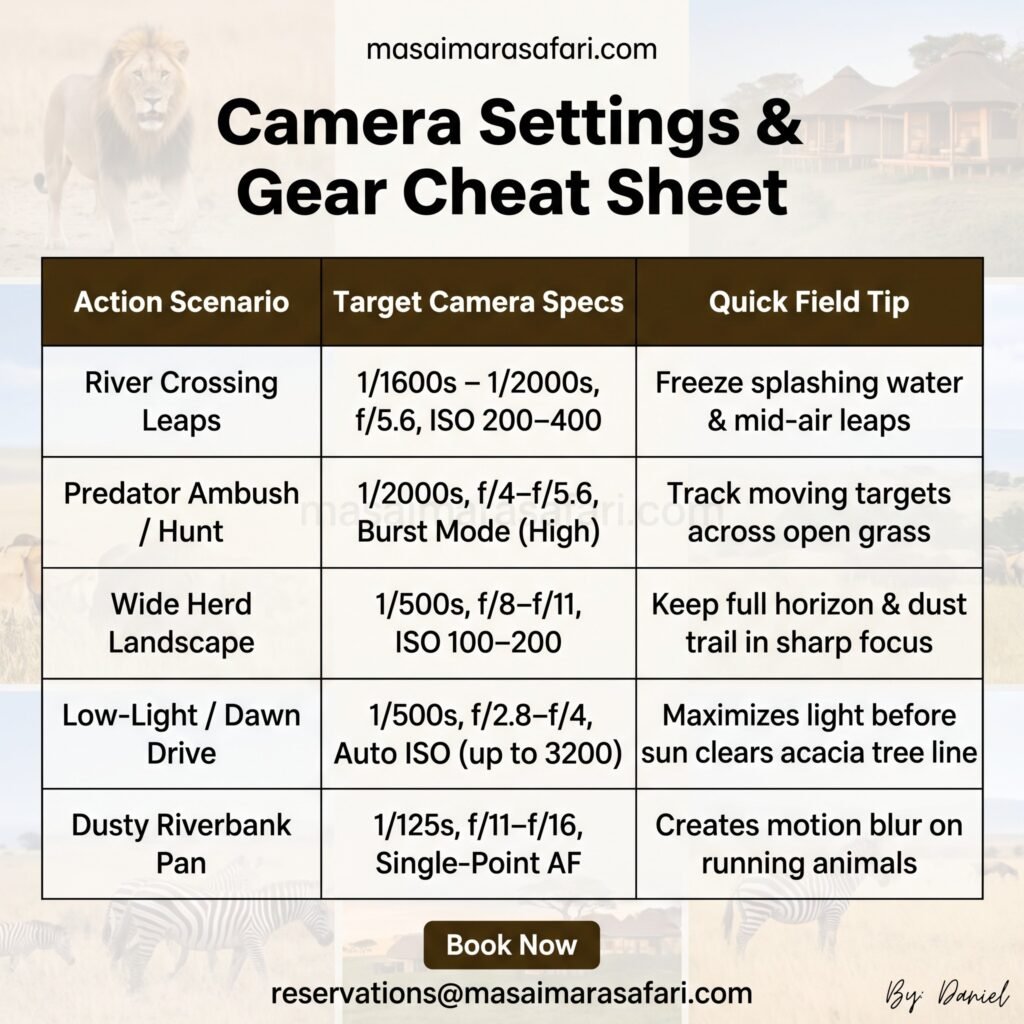
Camera Settings & Gear Cheat Sheet
To capture razor-sharp action shots during a high-speed Mara River crossing, you need to adjust your camera settings before the dust starts flying. Use this field-tested photography cheat sheet to configure your camera body, shutter speed, and lens focal length based on your specific shooting scenario.
| Action Scenario | Target Camera Specs | Quick Field Tip |
| River Crossing Leaps | 1/1600s – 1/2000s, f/5.6, ISO 200–400 | Freeze splashing water & mid-air leaps |
| Predator Ambush / Hunt | 1/2000s, f/4–f/5.6, Burst Mode (High) | Track moving targets across open grass |
| Wide Herd Landscape | 1/500s, f/8–f/11, ISO 100–200 | Keep full horizon & dust trail in sharp focus |
| Low-Light / Dawn Drive | 1/500s, f/2.8–f/4, Auto ISO (up to 3200) | Maximizes light before sun clears acacia tree line |
| Dusty Riverbank Pan | 1/125s, f/11–f/16, Single-Point AF | Creates motion blur on running animals |
Unfiltered Local Field Tradecraft for Migration Safaris
Migration tracking is mostly waiting. You stare at dry acacia trees for two hours. Nothing moves. Then the bank breaks, and it is total heart-in-your-throat chaos for ten minutes straight.
You can sit inside a baking 4×4 Land Cruiser at Cul-de-Sac #4 for three hours, drinking lukewarm thermos coffee while ten thousand wildebeest pace the cliff edge, only for a single spooked zebra to turn around and lead the entire herd away. That is real safari.
During peak August weeks, thirty safari vehicles will jockey for position at Main Crossing. A smart driver pulls back a hundred yards onto a higher embankment. You get a clear view over the top of other vehicles instead of staring at another tourist’s camera lens. Ask your lodge chef to pack fried chicken and cold fruit instead of dry sandwich boxes for long riverbank waits.
To plan the rest of the trip around the herds, read how many days you need in the Masai Mara or review weather timing in our guide on the best time to visit the Masai Mara.
Migration Safari Packing & Travel Logistics
- Flight Transfers: Fly-in packages utilize bush flights from Wilson Airport (WIL) operated by Safarilink directly to Ol Kiombo, Musiara, or Serena airstrips in 45 minutes.
- Luggage Rules: Aircraft enforce a strict 33-lb (15 kg) weight limit per passenger in soft-sided duffel bags without hard metal frames or wheels.
- Visa Regulations: All international travelers must apply online through the official Kenya eTA portal at least 72 hours before departure.
- USD Cash Conditions: Bring crisp US dollar bills printed after 2013 for tipping guides and buying local Maasai crafts. Local banks reject old or damaged bills.
- Clothing: Wear neutral khaki, tan, or olive layers. Avoid dark blue and black clothing, which attract biting tsetse flies near river loops.
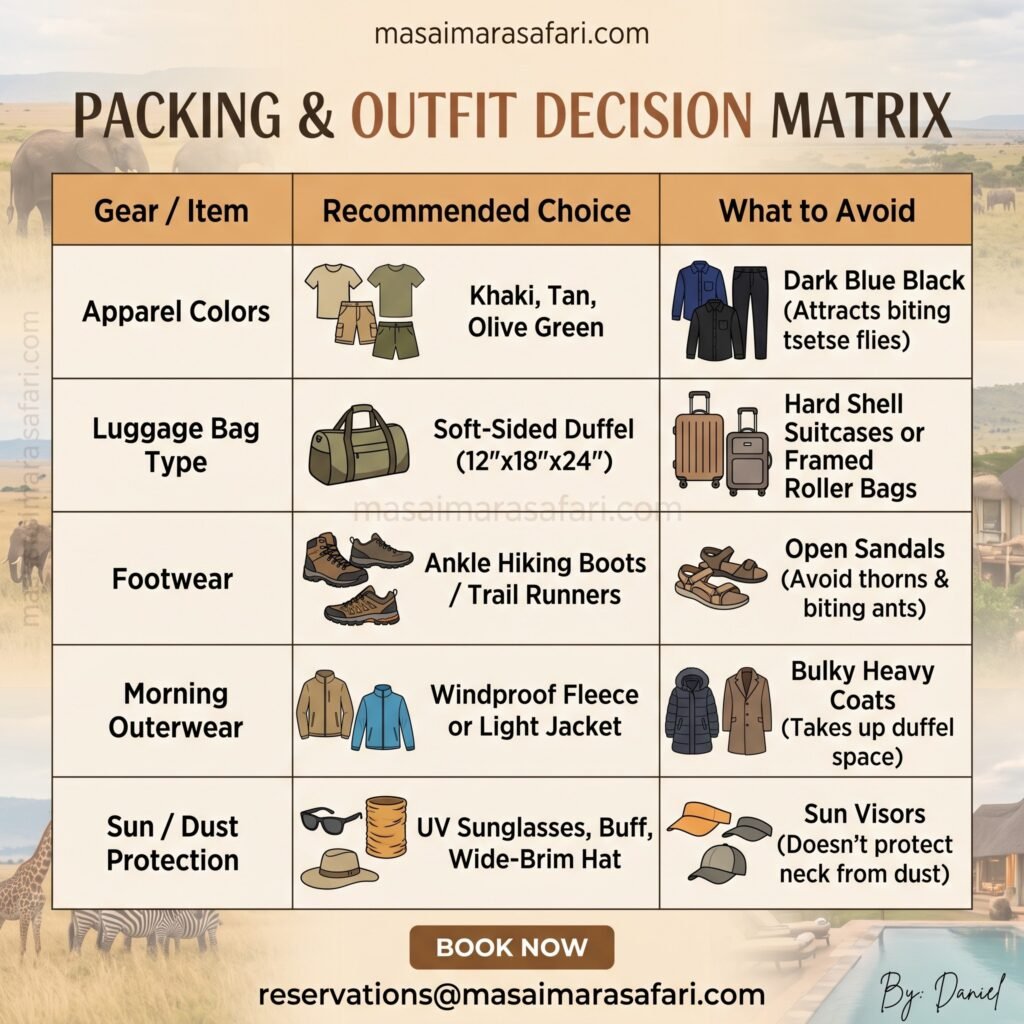
Packing & Outfit Decision Matrix
Packing correctly for a migration safari requires balancing strict light-aircraft luggage weight limits (15 kg / 33 lbs) with unpredictable weather conditions. The savannah ranges from freezing morning game drives to dusty midday heat. Follow this quick packing matrix to select neutral, multi-purpose apparel designed for long days at the riverbank.
| Gear / Item | Recommended Choice | What to Avoid |
| Apparel Colors | Khaki, Tan, Olive Green | Dark Blue & Black (Attracts biting tsetse flies) |
| Luggage Bag Type | Soft-Sided Duffel (12″x18″x24″) | Hard Shell Suitcases or Framed Roller Bags |
| Footwear | Ankle Hiking Boots / Trail Runners | Open Sandals (Avoid thorns & biting ants) |
| Morning Outerwear | Windproof Fleece or Light Jacket | Bulky Heavy Coats (Takes up duffel space) |
| Sun / Dust Protection | UV Sunglasses, Buff, Wide-Brim Hat | Sun Visors (Doesn’t protect neck from dust) |
Frequently Asked Questions
What is the Great Migration in Masai Mara?
The Great Migration in the Masai Mara is the annual arrival of over 1.5 million wildebeest and 200,000 zebras crossing from Tanzania’s Serengeti into Kenya between July and October. Driven by seasonal rains, herds face dramatic Mara River crossings to access fresh grazing pastures while tracking resident predators.
What is the best month to see the Great Migration in Masai Mara?
August and September offer the highest herd concentration and daily river crossings along the Mara River loops.
How much does a Great Migration safari cost?
A 3 to 5 day migration safari costs between $1,290 and $4,710 per person for 4×4 Land Cruiser road packages. Luxury fly-in migration options range from $5,240 to $8,290+ per person.
Are river crossings guaranteed during a safari?
No. River crossings are unpredictable animal behaviors. Increasing your stay to 4 or 5 days in the reserve gives you the best statistical chance of witnessing a crossing.
How do deposit payments and hotel vouchers work?
We require a 20% deposit to issue official hotel confirmation vouchers under your name. After contacting the lodge directly to verify your booking is paid, you pay a further 30% to reach 50%, with the final balance due at pickup.
Ready to witness the savannah’s greatest spectacle? Visit our booking portal to plan your Masai Mara safari and receive a tailored quote from our local team.